Sovereign AI sounds like a national strategy, or the premium tier on a vendor’s pricing page. On the ground it is almost always one sentence from someone in compliance: the data cannot leave the building. Not the country, the building. That sentence ended a six-week cloud architecture I was partway through and started a procurement cycle for racks, and some version of it has been the most common thing I have heard in regulated AI work this year.
For a long time the answer to “we need GPUs” was a region selector and a credit card, and for most teams it still is. A growing set of workloads, though, sits under a residency rule, a sovereignty clause, or a contract with a counterparty who will walk if their records touch a hyperscaler. When the legal boundary is a physical address, the cloud stops being a cheaper option you reluctantly skip and becomes no option at all. Inference comes home, onto a fixed fleet of GPUs you own, in a room you can point at.
I have built on both sides of this line. The on-prem version costs more than the spreadsheet admits, and the worst of that cost has nothing to do with money.
The build-vs-rent math is not the math you think
Everyone opens this decision as a unit-cost comparison. Dollars per GPU-hour rented versus dollars per GPU-hour owned, amortize the hardware over three years, find the break-even utilization, done. That arithmetic is real and worth running, though it decides far less than it looks like it should.
The decision is whether you can rent at all. If the data sits under a hard residency rule, the cloud price is effectively infinite, because the option does not exist for this workload. The math collapses to a single question: what does it cost to do the only thing you are allowed to do. That reframes the comparison completely, from cloud versus on-prem to on-prem versus not shipping the product at all.
For the workloads where you genuinely have a choice, the break-even splits along familiar lines. Rented GPUs win when your demand is spiky, when you are still discovering the workload, and when idle capacity would sit there mocking you. Owned GPUs win when demand is steady and predictable, when you will saturate the fleet, and when the data constraint or the long-run volume makes the rental meter unbearable. The hardware is the cheap part of owning. (The hardware is never the expensive part of anything.) The expensive parts are power, cooling, the supply chain, and the people who keep it alive at 3am.
The constraints that never make the slide
In the cloud, capacity is someone else’s problem, and elasticity hides every planning mistake you make. On-prem, the fleet is fixed, and every constraint you used to externalize lands on your desk at once.
Power is the first wall. High-end inference GPUs are not casually power-hungry, they are ravenous, and a rack of them can exceed what the building’s existing electrical feed was provisioned to deliver. You do not find this in a design review; you find it when facilities tells you the floor’s circuit cannot take another rack and the fix is a construction project with a permit.
Cooling is the second wall, and it arrives right behind the first, because every watt you push in comes back out as heat. Air cooling has a ceiling that a dense GPU rack blows straight through, which is how you end up in a conversation about liquid cooling that nobody on the team signed up for.
Supply is the third. You cannot autoscale a thing you have to wait months to take delivery of. Lead times on the good accelerators stretch, allocation is political, and the unit you spec today may not be the unit you can actually buy this quarter. Capacity planning without elastic scale means forecasting demand a year out and committing capital to that forecast, with no slider to nudge if you guessed low. Guess high and you own idle silicon. Guess low and you are rationing GPU time across angry teams while a purchase order crawls through procurement.
That is the trade you are signing. You traded a variable bill and infinite elasticity for a fixed asset and a hard ceiling. Nobody hands you that ceiling back.
Making a fixed fleet feel like a platform
A pile of GPUs is not a platform. Handed to teams raw, it turns into a land grab: the strongest team takes most of it and everyone else files tickets. The whole job of the software layer is to take a fixed, finite pool and make it behave like the elastic service it can never actually be.
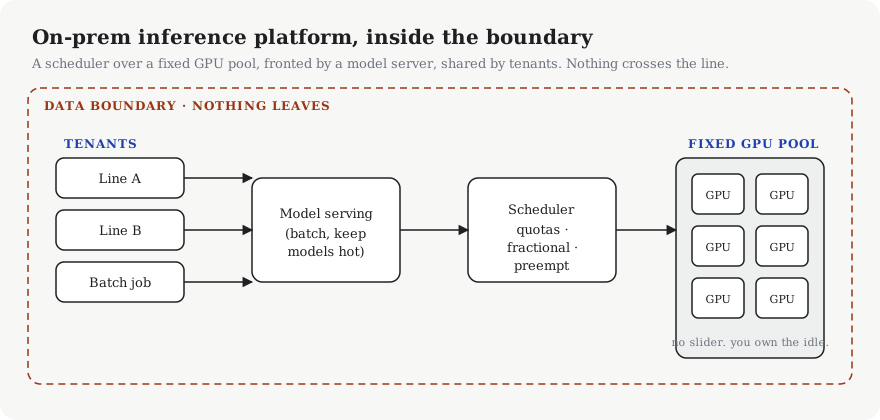
Everything lives inside the boundary. The scheduler is what turns a fixed pool into something that feels shared and fair.
Three layers earn their place.
A scheduler that understands GPUs, not just CPUs and memory. It has to handle fractional allocation, because not every model needs a whole accelerator, and stranding a full GPU on a small model wastes a fleet you cannot grow. Quotas per tenant matter just as much, so steady-state work and a sudden batch job do not starve each other. Preemption is the last requirement: the most expensive thing on the floor should not sit idle while a low-priority job hogs it.
A model-serving layer that batches aggressively and keeps hot models resident. Loading model weights onto a GPU is slow, so you do not want to pay that cost per request. Continuous batching, where the server packs requests from many callers into the same forward pass, is what turns a fixed throughput ceiling into respectable utilization. This layer decides whether your owned GPUs feel fast or feel like a queue.
Multi-tenancy with real isolation. Several teams, often several regulated lines of business, share one fleet, and one tenant’s traffic spike cannot become another tenant’s outage or, worse, another tenant’s data leaking through a shared cache. Isolation here is not a nice-to-have; it is frequently the reason you were allowed to build on-prem in the first place, and a sloppy version of it hands the auditor exactly the finding they came for.
Get those three right and a fixed fleet starts to feel like a service. Teams ask for capacity and get it, batches run, nobody knows or cares that under the platform there is a hard number of cards in a rack that will not change until next year’s budget.
The downside you own forever
The honest cost of owning the fleet is that you own the idle time too.
In the cloud, an idle GPU costs you nothing the moment you release it. On-prem, an idle GPU costs you the same whether it is running flat out or sitting dark, because you already paid for it, and it is still drawing power and throwing heat just to exist. Utilization is no longer a nice efficiency metric; it is the entire economic case. A fleet running at a fraction of capacity is a capital decision that aged badly, in a rack, where everyone can see it.
The work that never ends is squeezing utilization without breaking the isolation that justified the whole thing. The moves are always the same: pack more tenants on, batch harder, schedule off-peak training into the gaps that inference leaves. Every one of those moves trades a little safety for a little efficiency, and you are the one deciding how much, on a fleet that cannot grow to bail you out.
Strip the word “sovereign” off it and what remains is plainer: a fixed amount of compute, in a room, that you keep busy and keep separate at the same time, because the data was never allowed to leave. The teams that run it well are rarely the ones with the most GPUs; they are the ones who treat the ceiling as the design rather than the disappointment. The residency rule is the only honest reason most of these racks get built, and given a real option to rent, almost no one would.