Most teams that build a feature store build it a year before they need it. The problem it eventually solves is real, though, and worth seeing up close first.
A model that scored well in the notebook went to production and got dumber. Same features, same code, supposedly. The offline version computed a user’s average order value over the trailing thirty days from a warehouse table. The online version recomputed it from a Redis counter that reset on a deploy. Two functions named the same thing, drifting apart in the dark, and the only signal was a slow slide in conversion that took a quarter to notice. That is training/serving skew, the disease a feature store is built to cure.
I have built one. It ended up serving many product teams across recommendations, fraud, and demand forecasting, and I am glad it exists now. I also think we started it at least a year too early, and we paid for that.
A feature store is mostly an operational tax you agree to pay forever, in exchange for two specific guarantees that most teams do not need yet. If you cannot name which of those two guarantees is currently costing you money, you are building it because it looks good on the architecture diagram and better on the resume. (I have written that diagram, and it is a very satisfying diagram.)
What you actually pay for
Strip the marketing off and a feature store sells you exactly two things.
The first is online/offline parity. The same feature definition computes the same value whether you are training on a year of history or serving a single request in fifty milliseconds, so no Redis counter drifts away from the warehouse behind your back.
The second is point-in-time correctness. When you build a training set, every feature value has to be as-of the moment of the label, not as-of now. If your “thirty-day average order value” for a row dated in March accidentally includes April’s orders, you have leaked the future into the past, your offline metrics look spectacular, and the model faceplants in production because that information does not exist at decision time. A real feature store makes the point-in-time join the default instead of a step a careful engineer has to remember.
Both guarantees are worth real money, and neither is free.
The tax
The tax is everything around those two guarantees. A feature registry someone has to keep honest. A materialization pipeline that backfills history and keeps the online store fresh, which is a streaming job with its own failure modes and its own pager. An online store sized for low-latency reads, which is now a stateful system in your critical serving path. Monitoring for feature freshness and null rates, because a stale feature raises no error and the model trained on it raises no alarm. A migration story for the day a feature definition changes, which it will.
For a team with one model and one engineer who owns the whole vertical, that tax buys you almost nothing. That engineer already knows the feature is computed in two places and can keep the two in sync in their head, because it is their head and their model. Handing them a feature platform at that stage is like installing a freight elevator to move one box: the box still gets moved, it just costs more now.
The line where it flips
There are three conditions, and you want at least two of them true before you build.
Point-in-time correctness is biting you. You have a non-trivial training set with temporal features and someone has already shipped a model that overfit on leaked future data, or you have caught yourself writing a bespoke as-of join for the third time. The store stops being overhead the moment it is cheaper than getting that join right by hand, every time, forever.
The same feature is wanted by more than one team, and this is the big one. When the fraud team and the recommendations team both want “merchant transaction velocity over the last hour,” and they are each about to compute it slightly differently, the store earns its keep as a place that defines it once. The value of a feature store is roughly the number of features times the number of teams reusing them, which at a single team rounds to nothing.
Online and offline have already skewed on you in production. Not “might skew.” Did. You have a postmortem with the word “skew” in it. At that point parity is not an abstraction but a fix for something that already cost you a quarter, like my average-order-value ghost above.
If only one of these is true, you can usually buy the guarantee without buying the platform: a disciplined library that both paths import, a shared SQL definition, a nightly check that diffs online against offline for a sample of entities. Boring and cheap, and it gets you most of parity without an online store in your serving path.
What the boundary looks like in code
A feature store should make trivial the one operation teams get wrong by hand: the point-in-time join. Sketched, it reads “for each label, fetch features as they were at that label’s timestamp, never later.”
def point_in_time_features(labels, feature_view):
    # labels: rows of (entity_id, event_ts, y) we want to train on.
    # The whole game is the <= : a feature value is only allowed in
    # if it was known AT OR BEFORE the event. One > and you've leaked
    # the future into your training set and your offline AUC lies to you.
    rows = []
    for entity_id, event_ts, y in labels:
        history = feature_view.values_for(entity_id)   # ordered by valid_from
        known = [v for v in history if v.valid_from <= event_ts]
        latest = known[-1] if known else None          # as-of, not now
        rows.append({**(latest.payload if latest else {}), "y": y})
    return rows
The online read, using the same feature view, is the dull twin of that: no history, no join, just the current value for one entity, fast.
def online_features(entity_id, feature_view):
    # Serving path. Same feature_view object the trainer used, which is
    # the entire point: if these two functions ever resolve different
    # definitions, you've rebuilt the bug the store was supposed to kill.
    return feature_view.latest(entity_id)   # one read, low latency, no surprises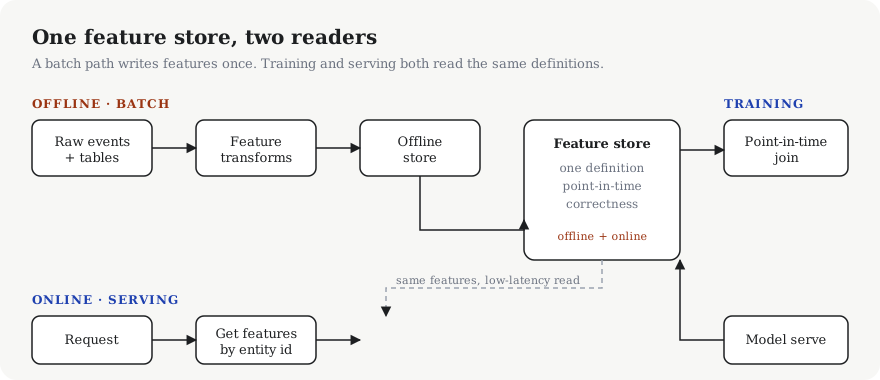
Offline transforms write features once. Training reads them through a point-in-time join, serving reads the same definitions live. The store earns its keep only when more than one reader actually depends on that being the same thing.
The diagram is clean because that is the promise. One definition flows into a batch path, a training join, and an online read, and nothing computes “average order value” twice. The mess the picture hides is the materialization job feeding the online store, the freshness it can lose, and the pager that comes with it. That mess is the tax you keep paying, and the single shared definition is the leverage you are weighing it against. You are deciding whether the leverage is worth the tax yet, and for a lot of teams the honest answer in their first year is not yet.
When to build one
Build it when reuse is real and skew has already hurt you, not when the roadmap says “ML platform” and the quarter needs a flagship. The version we shipped became genuinely load-bearing once several teams leaned on the same features and point-in-time joins stopped being something people had to remember to get right. The version we started, before any of that was true, was a freight elevator for one box. If you cannot point at the second team or the skew postmortem, your problem is discipline rather than infrastructure, and discipline is far cheaper to install.